A brief note on operator spectra
I keep forgetting basic definitions pertaining to the spectral theory of self-adjoint operators so I want to keep a few of them here as a reminder. I’ll illustrate the concepts with examples arising in the theory of Anderson localization.
A confusion that can occur especially when studying the physics literature, is that of
mixing up the various definitions and nomenclature related to the spectrum of an operator.
For example, the language usually used could leave one confused when meeting an operator
 with its spectrum equal to some continuous subset of the real line, yet having only a “pure
point spectrum”. Additionally, it is common to say an operator has pure point spectrum for
both the case in which it is entirely pure point or when it only has non-trivial pure point part
(like the Hamiltonian of the hydrogen atom), but not much can be done about this except to
pay attention to the context we’re in. This post is just a brief recollection of these
concepts.
with its spectrum equal to some continuous subset of the real line, yet having only a “pure
point spectrum”. Additionally, it is common to say an operator has pure point spectrum for
both the case in which it is entirely pure point or when it only has non-trivial pure point part
(like the Hamiltonian of the hydrogen atom), but not much can be done about this except to
pay attention to the context we’re in. This post is just a brief recollection of these
concepts.
1 Bare minimum spectral theory
What follows can be found in detail in M. Aizenman and S. Warzel’s Random Operators. A lot
of the following definitions apply to some broader class of linear operators, but we will
implicitly assume that we deal with self-adjoint operators. Let  be a densely
defined self-adjoint operator on some Hilbert space
be a densely
defined self-adjoint operator on some Hilbert space  . The resolvent set is defined
as
. The resolvent set is defined
as
| (1) |

and the inverse  is called the resolvent. The spectrum of
  is
is  ,
which is a closed subset of the real line. It can be shown that for any
,
which is a closed subset of the real line. It can be shown that for any  the function
defined by
the function
defined by
| (2) |

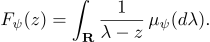
is a Herglotz-Pick function, which means that it is a holomorphic function  from the upper-half plane into itself. There is a representation theorem for these types of
functions which states that there exists a unique finite Borel measure
from the upper-half plane into itself. There is a representation theorem for these types of
functions which states that there exists a unique finite Borel measure  on
on  called the
spectral measure of
called the
spectral measure of  associated to
  , which satisfies
| (3) |
By polarization we obtain a complex finite Borel measure  , which can be used to define
a functional calculus for bounded functions
, which can be used to define
a functional calculus for bounded functions  satisfying
| (4) |

Of course the characteristic functions  are bounded for any Borel set
  and can be
used to define orthogonal projections
and can be
used to define orthogonal projections  . The map
  defined in this
manner is a projection-valued measure. The spectral theorem guarantees a correspondence
between these projection-valued measures and self-adjoint operators on
defined in this
manner is a projection-valued measure. The spectral theorem guarantees a correspondence
between these projection-valued measures and self-adjoint operators on  . In particular we
have
. In particular we
have  .
.
Having such a Borel measure  , Lebesgue’s decomposition theorem states that
  can
be decomposed with respect to the Lebesgue measure into three mutually singular
parts:
can
be decomposed with respect to the Lebesgue measure into three mutually singular
parts:
| (5) |

known as the pure point part, the absolutely continuous part and the singular continuous part, respectively. Occasionally one calls these parts, spectral components. Using these components, we can define the closed subspaces
| (6) |

where  is
is  or
or  . It turns out that the Hilbert space can be decomposed as a
direct sum of these subspaces:
. It turns out that the Hilbert space can be decomposed as a
direct sum of these subspaces:
| (7) |

with each summand being invariant under  . If
. If  is bounded, then restricting to these
subspaces defines the components of the spectrum
is bounded, then restricting to these
subspaces defines the components of the spectrum
| (8) |

where  is the pure point, absolutely continuous or singular continuous spectrum of
 .
.
From a slightly different perspective, we can define the discrete spectrum  as the
set of isolated eigenvalues of finite multiplicity of
as the
set of isolated eigenvalues of finite multiplicity of  . An isolated eigenvalue
  of
of  is one
for which there exists
is one
for which there exists  such that
  and any isolated point
in the spectrum is always an eigenvalue. The complement of
and any isolated point
in the spectrum is always an eigenvalue. The complement of  in
in  ,
denoted by
,
denoted by  , is called the essential spectrum. It can easily be shown that the
pure point spectrum is equal to the closure of the set of eigenvalues of
, is called the essential spectrum. It can easily be shown that the
pure point spectrum is equal to the closure of the set of eigenvalues of  and so
 .
.
We can produce a finer classification of spectra, and even more so for an unbounded operator, but we stop here since this is enough to already confuse oneself and is sufficient for the few examples that follow.
2 Illustration
Consider the graph (also discrete, finite-difference) Laplacian  for
for
 . For a function
  it is defined as
| (9) |

This is a bounded operator with  . We can compute its spectrum easily by using the
Fourier transform
. We can compute its spectrum easily by using the
Fourier transform ![F : ℓ2(Zd) → L2([0,2π]d)](spectral53x.svg) which is defined as
which is defined as
| (10) |

Then by direct computation we can show for any ![ϕ ∈ L2 ([0,2π]d)](spectral55x.svg) that
that
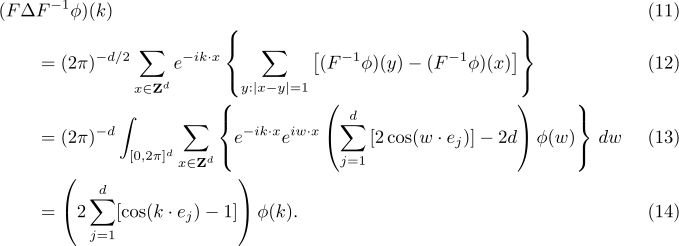
Thus  is unitarily equivalent to a multiplication operator on
 ![L2 ([0,2π]d)](spectral58x.svg) . Bounded
multiplication operators have as their spectrum the essential range, which in this case is the
interval
. Bounded
multiplication operators have as their spectrum the essential range, which in this case is the
interval ![[− 4d,0]](spectral59x.svg) . Thus
. Thus
| (15) |
![σ(− Δ) = [0,4d].](spectral60x.svg)
The Laplacian does not have eigenvectors (although the plane waves can be seen as
“generalized” eigenvectors). In fact, with a bit of work, we can show that  for all
 . This implies that the whole spectrum is essential:
| (16) |
![σ(− Δ) = σac(− Δ ) = σess(− Δ) = [0,4d].](spectral63x.svg)
Now consider a multiplication operator on  defined by some real-valued function
 . The spectral measure only has pure point part, given by a sum of Dirac
measures
. The spectral measure only has pure point part, given by a sum of Dirac
measures
| (17) |

Its eigenvectors consist of the localized functions  with corresponding eigenvalues
 with
with  . The closure of the eigenvalues gives the pure point spectrum. We require
more information on the function
. The closure of the eigenvalues gives the pure point spectrum. We require
more information on the function  to determine the nature of the discrete and essential
spectrum. By definition we know that the essential spectrum will consist of all infinitely
degenerate eigenvalues
to determine the nature of the discrete and essential
spectrum. By definition we know that the essential spectrum will consist of all infinitely
degenerate eigenvalues  along with the accumulation points of the full set of
eigenvalues.
along with the accumulation points of the full set of
eigenvalues.
2.1 Anderson localization
Now consider the Schrödinger operator  , where
  is a multiplication operator
whose action is to multiply a function
is a multiplication operator
whose action is to multiply a function  by an IID random variable with density
  at each
point of
at each
point of  . To be very precise requires defining the appropriate measure spaces but
we will ignore this, and only note that with a little ergodic theory one can show
that
. To be very precise requires defining the appropriate measure spaces but
we will ignore this, and only note that with a little ergodic theory one can show
that
| (18) |
![σ(H ) = [0,4d]+ supp ν,](spectral77x.svg)
with probability one. The model described by the random Schrödinger operator  is
well-known as the Anderson tight-binding model on the “lattice”
is
well-known as the Anderson tight-binding model on the “lattice”  . It describes a simplified
picture (no particle interactions) of the transport of an electron in a disordered medium,
e.g. in an impure crystal. Originally introduced by P. W. Anderson in 1958, it has
stimulated intense research in both solid state physics and more recently (through
generalizations of course) to condensed matter theory. The physicists have “known”
much about this model for a long time but somewhat surprisingly, there are still
many outstanding mathematical conjectures. The main phenomenon studied in
these models is that of localization. Roughly speaking, in a periodic crystal, one
expects electronic conductance, but the inclusion of disorder through these random
potentials can create an effect due to interference (also only conjectured), in which
the eigenfunctions of
. It describes a simplified
picture (no particle interactions) of the transport of an electron in a disordered medium,
e.g. in an impure crystal. Originally introduced by P. W. Anderson in 1958, it has
stimulated intense research in both solid state physics and more recently (through
generalizations of course) to condensed matter theory. The physicists have “known”
much about this model for a long time but somewhat surprisingly, there are still
many outstanding mathematical conjectures. The main phenomenon studied in
these models is that of localization. Roughly speaking, in a periodic crystal, one
expects electronic conductance, but the inclusion of disorder through these random
potentials can create an effect due to interference (also only conjectured), in which
the eigenfunctions of  become exponentially localized in the lattice. A common
consequence of this is that diffusion (as measured by the spreading of the wave
function) under the time evolution
become exponentially localized in the lattice. A common
consequence of this is that diffusion (as measured by the spreading of the wave
function) under the time evolution  is suppressed and conductance no longer
occurs.
is suppressed and conductance no longer
occurs.
For the one dimensional lattice,  has pure point spectrum with exponential
localization occurring for all strengths of disorder. For
has pure point spectrum with exponential
localization occurring for all strengths of disorder. For  , pure point spectra
with exponential eigenfunctions have been proven to exist at the “band edges”, i.e.,
at the extremes of the spectrum, and an entirely pure point spectrum holds for
sufficiently strong disorder. It is conjectured that for
, pure point spectra
with exponential eigenfunctions have been proven to exist at the “band edges”, i.e.,
at the extremes of the spectrum, and an entirely pure point spectrum holds for
sufficiently strong disorder. It is conjectured that for  there is no absolutely
continuous part, but proof of the emptiness of
there is no absolutely
continuous part, but proof of the emptiness of  is still wanting! Note that for the
one-dimensional lattice,
is still wanting! Note that for the
one-dimensional lattice, ![σ(H) = [0,4]+ supp ν](spectral86x.svg) , and since
, and since  , its
eigenvalues form a dense subset of the spectrum, but no “extended states” exist. Physical
theory (like the scaling theory) and substantial numerical evidence show that a
“mobility edge”, signalling a phase transition from an insulator to a metal, exists for
, its
eigenvalues form a dense subset of the spectrum, but no “extended states” exist. Physical
theory (like the scaling theory) and substantial numerical evidence show that a
“mobility edge”, signalling a phase transition from an insulator to a metal, exists for
 .
.
Things get much more complicated when considering interactions and relatively recent results indicating that (many-body) localization is an example of a failure of the eigenstate thermalization hypothesis have restored an intense interest in the field. As of now rigorous results exist only for the simplest of spin chains. Furthermore, the phenomenon of localization has ties to many other areas of research, including percolation theory and most interestingly, to the field of quantum chaology!